
The Return of a Legend
Multi Theft Auto (MTA), one of the longest-running and most influential modding projects in gaming history, has officially returned to GitHub. The repository was restored earlier this week after Take-Two Interactive failed to pursue legal action following the MTA team's DMCA counter-notice.
The restoration marks a significant victory for the modding community, though the situation remains precarious given Take-Two's history of aggressive intellectual property enforcement.
What Happened?
In early December 2024, Take-Two Interactive—parent company of Rockstar Games—allegedly sent a DMCA takedown notice to GitHub targeting the MTA repository. The notice claimed the project contained "leaked source code" from Grand Theft Auto: San Andreas.
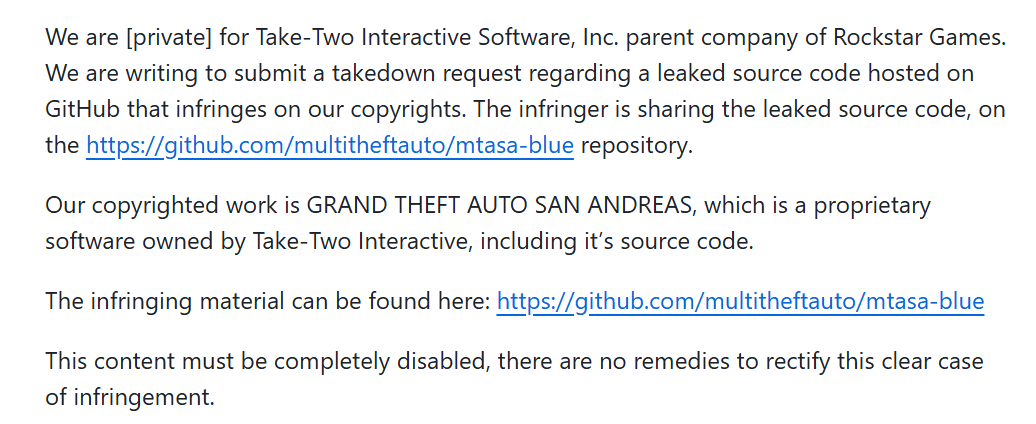
The takedown came as a surprise to the MTA development team. In their Discord channel, developers expressed skepticism about the notice's authenticity, particularly because:
- The entire repository was targeted without pointing to specific infringing code
- Repository forks were not included in the takedown—unusual for legitimate DMCA notices
- MTA has operated for over 22 years without serious legal challenges from Take-Two
MTA's Counter-Notice
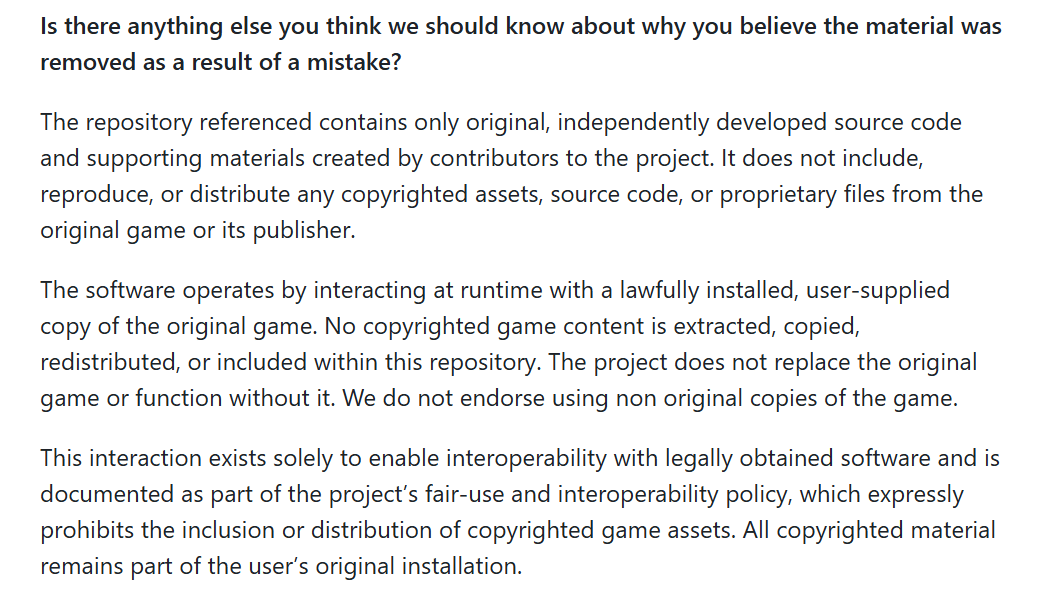
On December 22, 2024, the MTA development team filed a formal DMCA counter-notice with GitHub, firmly denying the infringement allegations.
Their response stated:
"The repository referenced contains only original, independently developed source code and supporting materials created by contributors to the project. It does not include, reproduce, or distribute any copyrighted assets, source code, or proprietary files from the original game or its publisher."
The developers emphasized that MTA operates through code injection and hooking techniques:
"The software operates by interacting at runtime with a lawfully installed, user-supplied copy of the original game. No copyrighted game content is extracted, copied, redistributed, or included within this repository."
How the DMCA Counter-Notice Process Works
Under the Digital Millennium Copyright Act (DMCA), when a counter-notice is filed, GitHub is required to restore the content within 10-14 business days—unless the original takedown requester files a federal lawsuit.
This creates a critical decision point: Take-Two had to either sue MTA's developers in court or allow the repository to come back online.
Take-Two chose not to sue.

GitHub confirmed they "reviewed and processed the notices in accordance with our DMCA Takedown Policy" but declined to comment further on the specific case.
22 Years of Multi Theft Auto
First released in February 2003, Multi Theft Auto was the first multiplayer mod for the Grand Theft Auto series. Starting with GTA III, the project eventually expanded to support Vice City and San Andreas.

Technical Approach
Unlike some other mod projects that have faced Take-Two's legal wrath, MTA has always maintained a careful technical approach:
- Requires legitimate game copies: MTA only works with officially purchased versions of GTA
- No game assets included: The mod contains zero copyrighted game content
- Code injection method: Works by hooking into the running game rather than modifying files
- Open source: The project has been fully open source for many years
By the Numbers (2025)
- 3,000-4,000 active game servers
- 600,000+ monthly players
- 200-1,000 concurrent players on top servers
- Winner of ModDB's 2011 Mod of the Year Player Choice Award
The Shadow of re3 and reVC
While MTA's restoration is a win, the modding community remains cautious. A similar situation played out with the re3 and reVC projects—reverse-engineered versions of GTA III and Vice City.
Those projects also successfully filed DMCA counter-notices and were briefly restored to GitHub. However, Take-Two eventually filed a federal lawsuit against the developers, forcing the repositories offline again.
The lawsuit dragged on until April 2023, when both parties reached an out-of-court settlement. The terms remain unknown, but the projects have never returned—suggesting the settlement required them to stay offline permanently.
Take-Two's History with GTA Modding
Take-Two Interactive has a complex and often contentious relationship with the GTA modding community.
The OpenIV Crisis (2017)
In June 2017, Take-Two sent cease-and-desist letters to the developers of OpenIV, the most popular modding tool for GTA IV and GTA V. The tool had operated for nearly a decade.
The community reaction was explosive:
- 80,000+ petition signatures to save OpenIV
- GTA V received overwhelmingly negative reviews on Steam
- Fans organized boycotts of Take-Two products
Rockstar eventually intervened, stating they "believe in reasonable fan creativity." Take-Two agreed not to pursue legal action against single-player, non-commercial mods—though this policy has been inconsistently applied.
Other Notable Takedowns
- GTA browser port (2024): DOS Zone's browser-playable version taken down despite requiring original game ownership
- Various mod projects: Continuous DMCA notices against tools and mods perceived to affect GTA Online revenue
What This Means for the Modding Community
MTA's survival demonstrates that well-structured mod projects can defend themselves against legal challenges—but only if they:
- Maintain clean code: No leaked or reverse-engineered game code
- Require legitimate copies: Don't distribute copyrighted content
- Document everything: Clear records of independent development
- Fight back legally: File counter-notices when appropriate
However, the threat never fully disappears. Take-Two could theoretically pursue legal action at any time, as they did with re3/reVC after initial restoration.
Looking Ahead
As GTA VI approaches its Fall 2025 console launch (with PC following in 2026-2027), the modding community faces uncertainty. Take-Two's tolerance for mods has fluctuated over the years, and a new flagship title could prompt renewed enforcement efforts.
For now, Multi Theft Auto continues to serve hundreds of thousands of players monthly—a testament to both the project's technical merit and its developers' willingness to stand their ground.
The MTA repository is once again available at github.com/multitheftauto. The project remains open source and actively developed after more than two decades.
Sources
- TorrentFreak - GitHub Restores Repo of GTA Mod 'Multi Theft Auto' After Take-Two Fails to Sue
- Kotaku - Popular GTA V Modding Tool Shuts Down, Community Explodes
- PC Gamer - Take-Two dismisses lawsuit against Grand Theft Auto modders
- GamesRadar - GTA owner settles lawsuit against creators of Vice City reverse-engineering project
- Multi Theft Auto Official Site
- GitHub DMCA Repository